 blog
blog
Best Christian Apparel Boutique Shopping 2026 Guide
Table of Contents
- What Shoppers Should Know About Christian Apparel Boutique Shopping in 2026
- How We Evaluated the Best Christian Clothing Brands
- What to Expect From Christian Apparel Boutiques Online
- Christian Apparel Sizing Guide: Fit, Fabric, and Inclusive Options
- Christian Clothing Trends 2026: What's Actually Selling
- Shopping by Occasion, Gift Recipient, and Category
- Returns, Exchanges, and Delivery: What to Check Before You Buy
- Frequently Asked Questions
Last Updated: October 16, 2026
What Shoppers Should Know About Christian Apparel Boutique Shopping in 2026
Christian apparel boutique shopping in 2026 looks different than it did a few years ago. According to Grips Intelligence category data, tracked online sales across Christian apparel and accessories retailers totaled $77 million in 2025, down 5 to 10 percent year over year.
A Christian apparel boutique is a curated online or physical store that sells faith-based clothing, jewelry, and accessories from a defined point of view, rather than a mass marketplace listing thousands of unrelated items.
That definition is the reason this guide exists. Below, we break down how to compare boutiques, what to expect on price and sizing, and which questions to ask before you add anything to your cart.
How We Evaluated the Best Christian Clothing Brands
We score boutiques on five criteria, weighted equally, so a brand cannot win on one strength alone. When shoppers ask how to compare the best Christian clothing brands, the answer is always the same: stop comparing logos and start comparing process.
- Design originality: Does the brand create its own graphics and silhouettes, or reprint generic stock art?
- Material transparency: Does the product page name the fabric and weight, or hide behind vague terms?
- Sizing range: Are extended sizes offered as core inventory or as an afterthought?
A common mistake is treating a polished homepage as proof of quality. In practice, the product page tells you far more than the homepage ever will.
What to Expect From Christian Apparel Boutiques Online
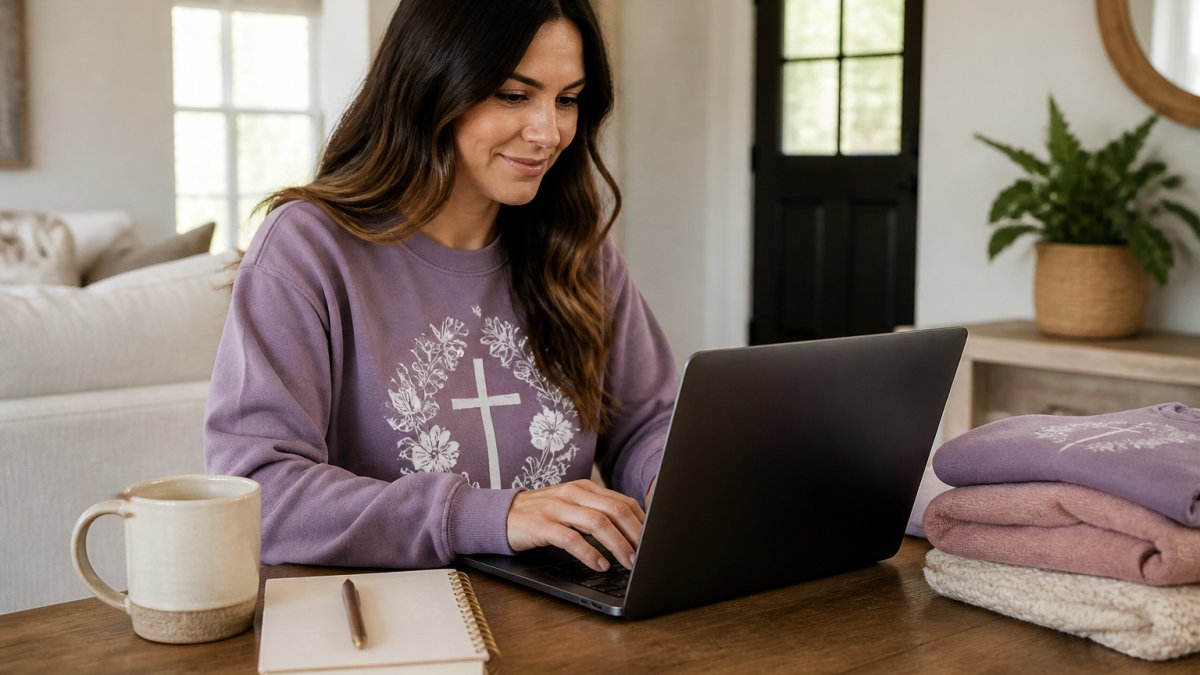
Most Christian apparel boutiques online run on a small-team model: a founder or family designs the graphics, sources blanks or cut-and-sew pieces, and ships from a single location.
Storefront Experience and Brand Authenticity
Authenticity shows up in small details. A boutique that names its founder, explains its mission, and shows real product photography is usually a real small business. One that uses only manufacturer stock images and no about page is usually a middleman.
Look for a stated mission. Elevated Faith's brand messaging and Walk In Faith Clothing's design philosophy both describe their apparel as a conversation starter about faith, which is a clear, checkable claim.
Price Ranges and Value by Product Category
This is the section most brand roundups skip, and it is the one shoppers actually need. Rather than publish a fixed price list that goes stale, here is the honest budget map for the category, based on what small-batch boutiques typically charge when they print on purchased blanks versus cut-and-sew their own pieces.
| Category | Typical Price Band | What Drives the Price | What to Check |
|---|---|---|---|
| Graphic tees | $25-$38 | Fabric weight, print method | Stated cotton weight, print durability |
| Long-sleeve and seasonal tops | $32-$52 | Fabric weight, cut | Layering fit, shape retention |
| Jewelry | $18-$65 | Metal type, plating | Tarnish resistance, clasp quality |
| Bags and accessories | $28-$75 | Material, hardware | Stitching, lining, strap attachment |
| Tumblers and gifts | $22-$45 | Insulation, finish | Lid seal, coating durability |
The price alone tells you almost nothing; the product page tells you everything.
Three value signals separate a fair price from an overpriced one:
- Fabric weight is stated in ounces or grams per square meter (GSM). A tee described as "premium cotton" with no number is a red flag. A tee listed at 6.0 oz or 180 GSM is telling you it will hold its shape.
- Print method is named. Screen print and DTG (direct-to-garment) behave differently. Screen print generally outlasts DTG on solid colors; DTG handles photographic or gradient art better. Neither is automatically "better", but a brand that names the method is a brand that knows its product.
- Cut-and-sew versus printed blank. Cut-and-sew pieces cost more to make and usually cost more to buy, but they fit the way the brand intended. Printed blanks are cheaper and fit like the underlying blank, often a unisex cut that runs large.
Shipping Thresholds and Bundling
Most small boutiques set a free-shipping threshold rather than offering flat free shipping, because they cannot absorb per-order carrier costs the way a mass retailer can. That threshold is also why bundling works: adding a second tee or a small accessory to clear the threshold is often cheaper than paying the flat shipping rate on a single item.
Check two things before you bundle: whether the threshold applies before or after discounts, and whether sale items count toward it. Some boutiques exclude discounted items from the free-shipping total, which quietly raises your real cost.
Christian Apparel Sizing Guide: Fit, Fabric, and Inclusive Options
A Christian apparel sizing guide matters more than most shoppers expect, because faith-based boutiques often run on unisex blanks that fit differently than fashion brands. A unisex medium is not the same as a women's medium, and the gap widens in long-sleeve and layered pieces.
Three things to check before ordering:
- Fabric weight and blend. Heavier combed cotton holds shape and takes prints better. Lighter fabric layers well but can cling.
- Fit language. "Relaxed," "classic," and "fitted" mean different things across brands. Read the size chart, not the model's height.
- Size range. Inclusive sizing means extended sizes are stocked and photographed, not listed as a special order.
Christian Clothing Trends 2026: What's Actually Selling
The honest answer about Christian clothing trends in 2026 is that the data does not support the "exploding market" narrative some brand blogs push. Grips Intelligence's 2025 category report shows tracked online sales fell 5 to 10 percent, even as some roundups claim continued growth without publishing a number.
What is actually moving: wearable, minimalist designs that work outside church settings. Bold scripture graphics still sell, but the strongest performers are pieces a shopper can wear to work, school, or youth group without feeling like a billboard.
- Scripture-inspired pieces with small, clean typography
- Neutral colorways that layer under jackets
- Matching accessory sets for gifting
- Seasonal drops tied to holidays and church calendar moments
Shopping by Occasion, Gift Recipient, and Category
Gift shopping is where most boutiques win or lose a customer for life. The category you shop in should follow the recipient, not your own taste.
For teenagers and young adults, graphic tees and hats in current cuts land best. For mothers and daily-wear shoppers, long-sleeve tees and comfortable layering pieces get worn most. For church friends and hostess gifts, jewelry, handbags, and inspirational tumblers solve the "what do I bring" problem cleanly.
Returns, Exchanges, and Delivery: What to Check Before You Buy
The return window is the single most important line on any boutique's site, and it is the one shoppers skip. Before you buy, confirm four things: the return window length, who pays return shipping, whether exchanges or store credit only are offered, and whether sale items are final.
Here is what normal looks like in this category, so you can tell a fair policy from a stingy one:
| Policy Element | Typical Boutique Standard | Warning Sign |
|---|---|---|
| Return window | 14-30 days from delivery | Under 14 days, or "contact us" with no number |
| Return shipping | Buyer pays, unless the item is defective | Buyer pays even for defects |
| Refund vs. store credit | Refund to original payment method | Store credit only, with no refund option |
| Sale and clearance items | Often final sale | Final sale on everything, including full-price items |
| Exchanges | Offered, sometimes with a restocking fee | No exchange path at all |
A 30-day window is a reasonable, common standard. A 14-day window with store-credit-only refunds is tighter than most shoppers expect, and it is worth knowing before you commit.
Delivery Expectations
Small boutiques often ship in batches rather than daily, so a stated handling time of two to three business days is normal, not a red flag. What is a red flag is a site with no stated handling time at all.
Two delivery details are worth checking on every order:
- Handling time versus transit time. Handling is how long the boutique takes to pack and hand off your order. Transit is how long the carrier takes after that. A site that says "ships in 2-3 days" is describing handling, not delivery. Add carrier transit on top.
- Tracking and carrier. Most small boutiques ship via USPS or UPS and email a tracking number. If a site does not mention tracking, assume you will not get it.
Pre-Order and Made-to-Order Items
Some boutiques sell pre-order or made-to-order pieces, especially seasonal drops tied to holidays and the church calendar. These ship later than in-stock items, sometimes by several weeks. The product page should state the expected ship date. If it does not, ask before you buy, a pre-order item with no stated date is the most common source of "where is my order" frustration in this category.
The Shipping Offer Fine Print
Confirm the shipping offer terms before checkout. "Free shipping" thresholds change by season, so read the current terms rather than relying on a screenshot or a review from last year. Two fine-print items trip up shoppers most often: whether the threshold is calculated before or after discounts, and whether it applies to the full order or only to full-price items.
A Quick Pre-Checkout Checklist
Before you pay, confirm all six of these on the boutique's site:
- Return window length, in days, from delivery.
- Who pays return shipping, and whether defects are covered.
- Refund to original payment method, or store credit only.
- Sale-item return policy.
- Stated handling time, separate from transit time.
- Free-shipping threshold terms, including discount exclusions.
If a boutique answers all six clearly, it is telling you it has thought about the customer after the sale, not just before it. That is the clearest signal of a boutique worth returning to.
Frequently Asked Questions
What should I look for when buying Christian clothing online?
Focus on fabric quality, sizing details, and the brand's mission. Look for soft, durable materials like combed ring spun cotton, and check whether the brand clearly describes its sizing and return policy. Read customer reviews about how graphics hold up after washing. A boutique that shares its story and values helps you confirm you're supporting a real small business, not a dropshipper. Also verify shipping timelines and return windows before you buy.
How do I choose the right size when shopping at a Christian apparel boutique?
Start by checking the brand's specific size chart, since fits vary between boutiques. Measure your chest, waist, and hips, then compare to the chart rather than assuming your usual size. If you prefer a relaxed fit, size up. Look for brands that offer inclusive sizing and note whether items are pre-shrunk. When in doubt, order two sizes if returns are free, or contact the boutique directly for fit advice.
Are Christian boutique clothes good quality?
Quality varies by brand, so check the materials and construction details. Many boutiques use 100% combed ring spun cotton, which resists pilling and holds shape. Look for tear-away labels, reinforced seams, and clear care instructions. Reviews mentioning durability after multiple washes are a good sign. If a brand publishes its sourcing or manufacturing process, that transparency usually points to better quality. Avoid brands that don't list fabric content or care details.
What are popular Christian apparel trends in 2026?
Minimalist designs with subtle scripture references are growing, along with conversation-starting graphics that work for everyday wear. Modern, wearable styles that layer easily are in demand, as are accessories like handbags and tumblers that carry faith messaging. Seasonal and inspirational themes remain popular for gifts. Overall, shoppers want pieces that express faith without feeling preachy, and they're prioritizing comfort and durability over fast-fashion trends.